LFP vs NMC Batteries: Which Is Better for Homes and EVs?
LFP vs NMC, compared on energy density, cycle life, safety, cost and cold weather, for home batteries and electric cars.
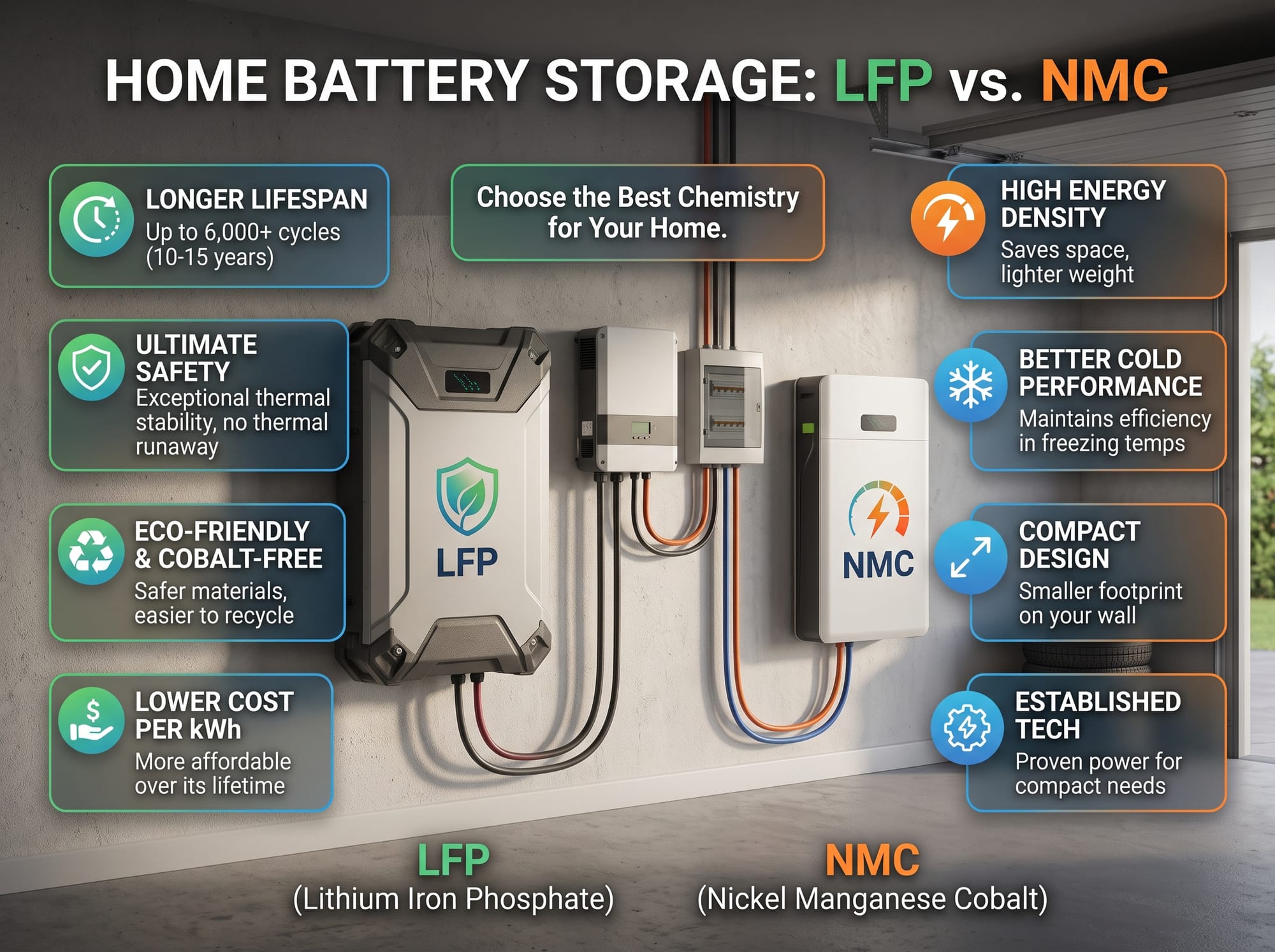
• An LFP battery uses a lithium iron phosphate cathode. It has no nickel and no cobalt. An NMC battery uses nickel, manganese and cobalt.
• LFP stores less energy per kilogram. It generally lasts more cycles, costs less per kilowatt-hour, and is harder to push into thermal runaway.
• NMC is the usual choice when a car must go a long way without a huge, heavy pack. LFP is the usual choice for home batteries and for many standard-range cars.
• Cold weather is LFP's weak point. The car or the home system has to heat the cells before a fast charge.
LFP vs NMC is a choice of cathode, and the cathode decides the rest of the pack. Both are lithium-ion batteries with a graphite anode and a liquid electrolyte. Change the cathode from iron phosphate to a mix of nickel, manganese and cobalt, and you change the energy in each kilogram, the number of deep cycles you can expect, the price, and how the cell behaves when it is abused or frozen. Neither chemistry is "the good one" on every row of the table. The right question is which row matters for a house, and which row matters for a car.
LFP vs NMC at a glance
The Faraday Institution's Insight 18 (2023) puts the contrast in one place. LFP offers longer cycle life and longer calendar life, and it avoids cobalt. Its cell-level energy density is lower than NMC or NCA (nickel cobalt aluminium, the other common nickel cathode). Cell-to-pack designs, including BYD's Blade and packs from CATL, recover some of that gap by wasting less space on modules. Faraday's conclusion is the one installers use: LFP fits shorter-range vehicles and stationary storage. NMC fits vehicles where mass and volume are the constraint.
A 2024 peer-reviewed comparison in Future Batteries is in the same direction, with numbers that belong to that paper rather than to every factory. It describes LFP as the safer chemistry, with life beyond 2,000 cycles in the work it reviews, and on the order of 30% lower cost in that study's scope. It cites NMC energy density up to about 260 Wh/kg. Do not read 260 Wh/kg, or 2,000 cycles, as the rating of the battery in a showroom. Those are literature figures. The warranty in the box is the number that binds the seller.
| LFP battery | NMC | |
|---|---|---|
| Cathode | Lithium iron phosphate. No nickel, no cobalt. | Lithium nickel manganese cobalt. |
| Typical nominal cell voltage | About 3.2 V | About 3.6–3.7 V |
| Energy density | Lower at cell level. Pack design can close part of the gap. | Higher. The 2024 paper cites figures up to about 260 Wh/kg. |
| Cycle life | Longer. Faraday highlights cycle and calendar life. One review cites beyond 2,000 cycles. | Shorter in the same comparisons. Enough for a car that is not fully cycled every day. |
| Safety | More resistant to thermal runaway. | More energy in a smaller box, so the pack design has to work harder. |
| Cost | Usually lower per kWh. About 30% lower in the 2024 study's scope. | You pay for range and for a lighter car. |
| Cold weather | Charge acceptance drops sharply near and below freezing. | Better than LFP in the cold, and still managed by the car. |
| Where it shows up | Home batteries, grid storage, buses, many standard-range cars. | Long-range cars and some performance trims. |
What an LFP battery is good at
An LFP battery likes a simple life: many cycles, a wide state-of-charge window, and a cathode that does not depend on nickel and cobalt prices. Iron and phosphate are abundant. That supply story is a real reason LFP took the home-storage market and a large share of Chinese electric cars. Faraday notes the stationary and shorter-range cases specifically. A home battery that cycles most days is buying cycle life. A car that does 250 km on a charge, and is not trying to be the lightest, can give up some watt-hours per kilogram and gain a cheaper pack.
Several mass-market standard-range cars use LFP, including BYD's Blade pack and a large number of standard-range Teslas. Long-range trims of the same brands have more often stayed with a nickel chemistry, because the alternative is a heavier car or less range. The mix changes by factory and by model year. [CHECK the chemistry on the build sheet of a specific car. A badge does not tell you.]
The flat voltage curve is the everyday quirk. An NMC cell's voltage falls steadily as it empties, which makes a rough state-of-charge estimate easy. An LFP cell holds a similar voltage over much of the middle of the curve. The car or the home inverter has to count charge in and out, not just glance at voltage. That is a software problem, and it is solved, but it is why an LFP monitor sometimes jumps from 40% to 30% if the count has drifted. A full charge now and then gives the meter a known point to reset against. Follow the manual rather than a forum rule.
Energy, safety and a worked cycle count
Range is energy divided by consumption, and energy is voltage times capacity. LFP's lower nominal voltage (about 3.2 V against about 3.7 V) and its lower capacity per kilogram both point the same way: for the same range, the pack is larger or the range is shorter. Cell-to-pack construction, where the cells are the structure of the pack, is how makers have narrowed that gap without inventing a new cathode. It does not repeal the gap.
Safety is the row where LFP wins without a footnote about driving style. The phosphate cathode releases oxygen less readily when it is overheated, so the step into thermal runaway is harder to reach. NMC packs are safe when the cooling, the fuses and the software are done well. They have less margin when they are not. For a battery screwed to a garage wall, that margin is the point.
Here is a cycle sum with the 2,000-cycle floor from the 2024 review, not a warranty. A home that moves 10 kWh a day through the battery uses one full equivalent cycle if the battery is 10 kWh, or half a cycle if it is 20 kWh. At one full cycle a day, 2,000 cycles is 2,000 ÷ 365 ≈ 5.5 years. At half a cycle a day it is about 11 years. Faraday's point on calendar life matters here: a battery also ages when it sits. A pack that is still at 80% after 2,000 cycles on a test bench may hit a calendar limit first in a cool garage that only cycles hard in summer. [CHECK the warranty years and the cycle count together. A "6,000-cycle" brochure that is silent on temperature is not a result.]
| Daily energy through a 10 kWh LFP pack | Equivalent full cycles per year | Years to 2,000 cycles |
|---|---|---|
| 5 kWh (half a cycle) | About 183 | About 11 years |
| 10 kWh (one cycle) | 365 | About 5.5 years |
| 15 kWh (one and a half) | About 548 | About 3.6 years |
NMC would spend those cycles faster in the same comparison, which is acceptable in a car that rarely does a full cycle every day. It is a weak bargain in a house that does.
Cold weather
Below freezing, LFP does not want to be charged hard. Lithium can plate onto the anode instead of sliding inside it, and plated lithium is permanent damage. Cars with LFP packs heat the battery before they allow a DC fast charge in winter. That heating is why the first minutes at a stall can show almost no kilometres added. NMC is more willing in the cold, which is one reason it has stayed in cars sold into harsh winters, but it is not immune. Both chemistries lose driving range in the cold because the cabin heater and the thicker oil in the tyres and the gearbox demand energy. The charging limit is the part that is specifically worse for LFP.
Home batteries usually live indoors or in a mild enclosure. If yours will sit outside in a climate that freezes, the datasheet must show a charge-temperature window, and the installer must fit the heater the maker specifies. [CHECK that line before you compare two quotes on price alone.]
For a house, start with LFP unless a specific high-power NMC product has a warranty you have actually read. For a car, let the range and the climate choose: LFP for a standard-range car you can charge often, NMC when you need the kilometres and the winter margin. Ignore a single "best battery" headline. Ask for chemistry, usable kWh, cycle or year warranty, and the temperature window.
Frequently asked questions
Which is better, LFP vs NMC?
LFP is the better default for homes and for many standard-range cars. NMC is the better default when the car has to carry a lot of energy and stay as light as possible. "Better" without that sentence is advertising.
Is an LFP battery safer?
It is harder to drive into thermal runaway. That is the finding both Faraday and the 2024 comparison describe. It does not make a crushed or badly installed pack safe. Installation quality still matters.
Why do long-range EVs still use NMC?
Watt-hours per kilogram. An LFP pack with the same range is heavier and larger. Some buyers will accept that. Many long-range trims do not.
Can I charge an LFP battery to 100% every day?
Makers of LFP cars often allow a higher daily limit than they recommend for NMC, because the chemistry is less stressed at the top of the curve. Use the limit in your manual. A full charge also helps the state-of-charge meter stay honest.
Does LFP really last longer?
In published comparisons, yes, on cycle life and often on calendar life. The 2,000-cycle figure above is from one review, not from your warranty card. A cool room and a shallow daily cycle help either chemistry.
Will LFP replace NMC completely?
It has already taken stationary storage and a large part of the mass-market car. Nickel chemistries remain where energy density pays for itself. Expect both, not a single winner.
Sizing a battery bank for a cabin or a pump? The off-grid battery tab in our engineer's toolbox turns daily watt-hours, days of backup and depth of discharge into amp-hours. It does not choose LFP or NMC. That choice is the table above. Grid-scale versions of the same idea are on the project atlas, including Hornsdale.