What Is a Battery Energy Storage System (BESS) and Why Grids Need It
A battery energy storage system stores grid electricity for minutes or hours. Here is what the MW and MWh mean, and what Hornsdale actually is.
• A battery energy storage system is a grid-connected battery, rated in megawatts (how fast it can charge or discharge) and megawatt-hours (how long it can keep that up).
• Hours of storage = MWh ÷ MW. Hornsdale in South Australia is 150 MW / 194 MWh, about 1.3 hours at full power.
• Grids use these systems for frequency, for peaks, and to move solar and wind by a few hours. They are not a way to store summer for winter.
• IRENA's 2024 figures already show some solar-plus-battery projects in the same cost range as new gas, in the markets it measured.
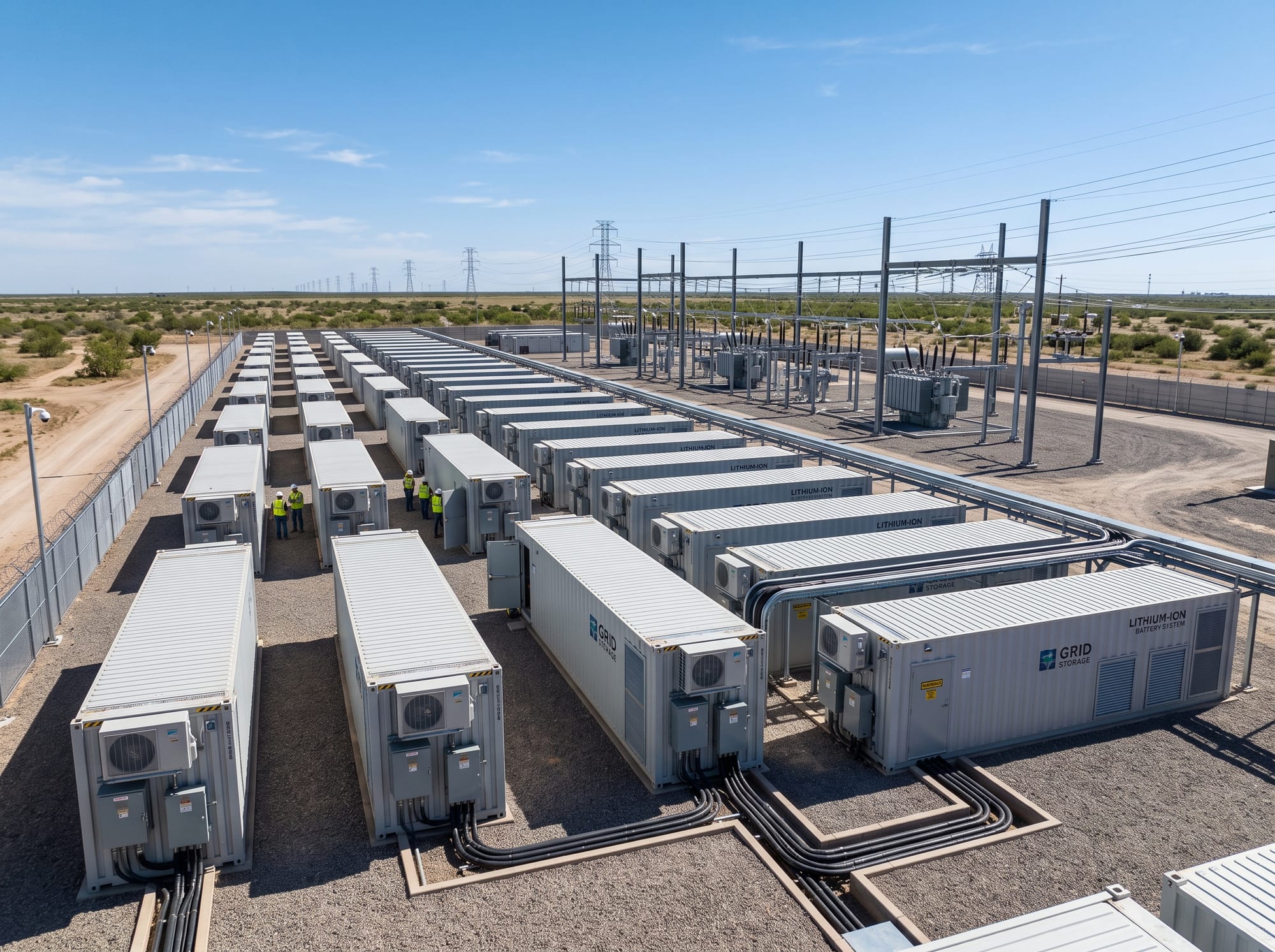
A battery energy storage system is a battery, an inverter and a control system tied to the power grid, or to a large site that behaves like a small grid. People shorten it to BESS. It does not make energy. It moves energy from an hour when electricity is abundant, or when the grid's frequency is high, to an hour when it is scarce or the frequency is low. That sounds modest. On a grid with a lot of solar and wind, it is the difference between switching plants off at noon and keeping the lights steady at 7 pm.
Battery energy storage system: power and energy are different
Every serious description of a battery energy storage system quotes two numbers, and mixing them up is the usual mistake. Megawatts are power: the rate. Megawatt-hours are energy: the tank. A 100 MW / 200 MWh system can deliver 100 MW for two hours, or 50 MW for four hours, before it is empty, ignoring losses. Duration at full power is simply MWh ÷ MW.
| Nameplate | Duration at full power | What that duration is for |
|---|---|---|
| 100 MW / 100 MWh | 1 hour | Fast response, short peaks, frequency. |
| 100 MW / 200 MWh | 2 hours | A sharp evening peak. |
| 100 MW / 400 MWh | 4 hours | Shifting a block of midday solar into the evening. |
| 50 MW / 400 MWh | 8 hours | Same energy as the row above, half the power, twice the time. |
The last two rows hold the same energy and do different jobs. Buying more megawatts makes the battery faster. Buying more megawatt-hours makes it last longer. Cells, racks and land scale with the megawatt-hours. Inverters and the grid connection scale with the megawatts. A quote that gives only "100 MW of storage" has not told you whether the tank is empty in one hour or in four.
Round-trip efficiency is the share of charged energy you get back. Lithium systems on the grid are high, often discussed around 85% and up, because the path is electrical rather than a fuel that you burn. [CHECK the measured efficiency on the project sheet you are reading. A brochure and a year of operation are not the same number.] The losses show up as heat, which is why a big site has cooling plant and a fire strategy, not just containers of cells.
Why a grid wants grid battery storage
Grid battery storage earns its keep in four jobs, sometimes in the same afternoon.
The first is frequency. Supply and demand must match every second. If demand jumps or a plant trips, frequency falls. A battery with its inverter already online can push power out in milliseconds, which a gas turbine cannot. This was the original job of the Hornsdale Power Reserve in South Australia, built after the statewide blackout of September 2016. Neoen and Tesla were selected by the state government. The first stage, commissioned in 2017, was 100 MW / 129 MWh.
The second is peaks. A few hours a year, or a few hours each evening, set the amount of power plant a grid thinks it needs. A battery that covers those hours lets the operator avoid starting an expensive peaker, or avoid building one.
The third is shifting. Solar peaks at noon. Household demand often peaks after sunset. A four-hour battery charges from solar that would otherwise be curtailed and discharges into that evening. Wind has the same problem on a different clock. IRENA's 2024 cost report already treats hybrids as their own class: 17 operating US projects, combining 4,486 MW of solar with 7,677 MWh of batteries, had a weighted-average cost of electricity of $0.079/kWh. That sat next to the midpoint IRENA quotes for combined-cycle gas ($0.077/kWh) and below coal ($0.119/kWh). Eight Australian hybrids, 412.2 MW of generation and 188.4 MWh of storage, came in at $0.051/kWh. These are specific fleets, not a promise that every battery project beats gas.
The fourth is system strength. The Hornsdale expansion report describes the plant providing inertia-like support, up to about 3,000 megawatt-seconds, against a shortfall the market operator had put near 6,000 megawatt-seconds for South Australia. That is a grid service, not extra energy for customers. It is also a reminder that a BESS is a power-electronics plant. The cells are only part of it.
Hornsdale, worked out in hours
The expansion, supported by ARENA and the South Australian government, added 50 MW / 64.5 MWh to the original 100 MW / 129 MWh. Neoen's knowledge-sharing report states the combined plant as 150 MW / 194 MWh. Divide energy by power: 194 ÷ 150 = 1.3 hours at full output. The original stage was 129 ÷ 100 = 1.3 hours as well. The expansion made the plant more powerful and gave it more energy, and it did not turn it into an all-night store.
| Hornsdale stage | Power | Energy | Hours at full power |
|---|---|---|---|
| Original, 2017 | 100 MW | 129 MWh | 1.3 h |
| Expansion | 50 MW | 64.5 MWh | 1.3 h |
| Combined | 150 MW | 194 MWh | 1.3 h |
Run it slower and the clock stretches. At 75 MW, half power, 194 MWh lasts about 2.6 hours, before losses. That trade is available to the operator all day: a short burst at full power when frequency moves, or a longer trickle when the job is energy. The site shares its network connection with the Hornsdale wind farms, so the battery and the wind are neighbours, not a single hybrid on one contract. Our project atlas marks the plant at 150 MW. The 194 MWh, which the atlas does not show, is the number that tells you the duration.
What a battery will not do
A 4-hour battery cannot hold a sunny June for a dark January. Seasonal storage needs a fuel, a reservoir, or a volume of hydrogen that is a different project with a different cost. IEA's work on low-emissions hydrogen exists partly because batteries stop being the right tool once the job is weeks rather than hours. Using a battery for that job would mean an enormous stack of cells that sit full for months. The capital cost would be paid by only one cycle a season.
A home battery is the same physics at a thousandth of the scale. Ten kilowatt-hours will move one evening of a household's use. It will not move a household through a week of rain unless the house uses very little and the array is large. The grid version and the garage version fail in the same way when someone confuses a tank of a few hours with a tank of a season.
Real: batteries already stabilise grids, and Hornsdale has done that job in public since 2017. Pairing solar with a few hours of storage is now a costed option in IRENA's data, not a concept.
Hype: "the battery will replace the power station" with no mention of hours. A 1.3-hour plant replaces a peaker's worst hour. It does not replace a fleet that runs all winter.
Verdict: ask for MW, MWh and the service the project is paid for. Duration tells you which claim is serious.
Frequently asked questions
What is a battery energy storage system in one sentence?
A grid-scale battery that absorbs electricity and releases it later, fast enough to matter to frequency and large enough to matter to the evening peak.
How is grid battery storage different from a home battery?
The physics is the same. The grid unit is megawatts, it follows a market or a system operator, and it is built with utility inverters, fire separation and a connection agreement. A home unit follows a tariff and a household.
Why quote both MW and MWh?
MW is speed, MWh is size. Hornsdale's 150 MW sounds like a power station. Its 194 MWh says the full speed lasts about 1.3 hours. You need both.
Can batteries store renewable energy for the winter?
Not at a cost that makes sense with today's cells. Hours, yes. A season, no. That is a job for fuels, hydrogen, or large hydro reservoirs where the geography exists.
Do solar-plus-battery plants cost more than gas?
IRENA's 2024 sample of 17 US hybrids averaged $0.079/kWh, close to the gas figure it quotes and below coal. Other places, and other hours of storage, will differ. One sample is not a universal win.
Are the cells always lithium iron phosphate?
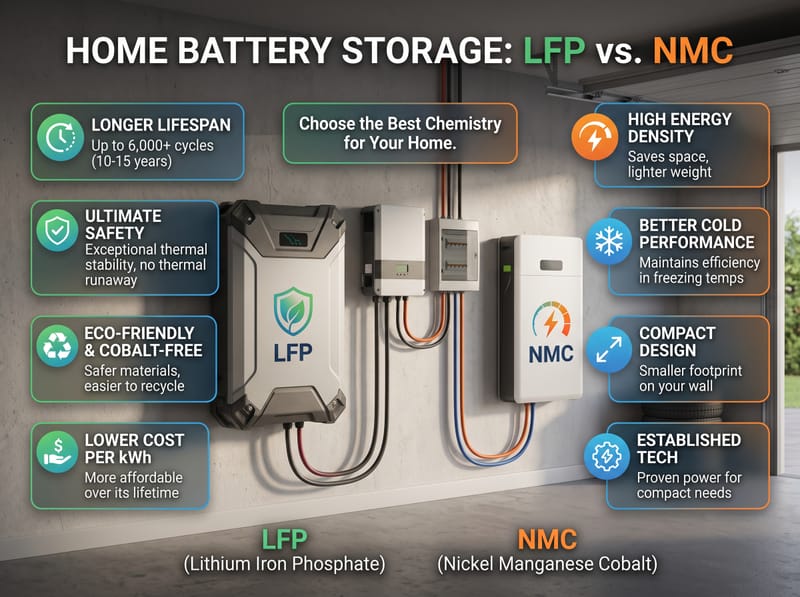
Most new stationary projects lean to LFP because of cycle life, cost and safety. Older projects and some high-power designs use other lithium chemistries. The chemistry is a line in the datasheet, not something you can guess from the container.
See Hornsdale on a map next to solar and wind projects in our project atlas. For a single house or a cabin, the battery tab of the engineer's toolbox sizes amp-hours from daily use. For the cell chemistry behind both, read LFP vs NMC.